
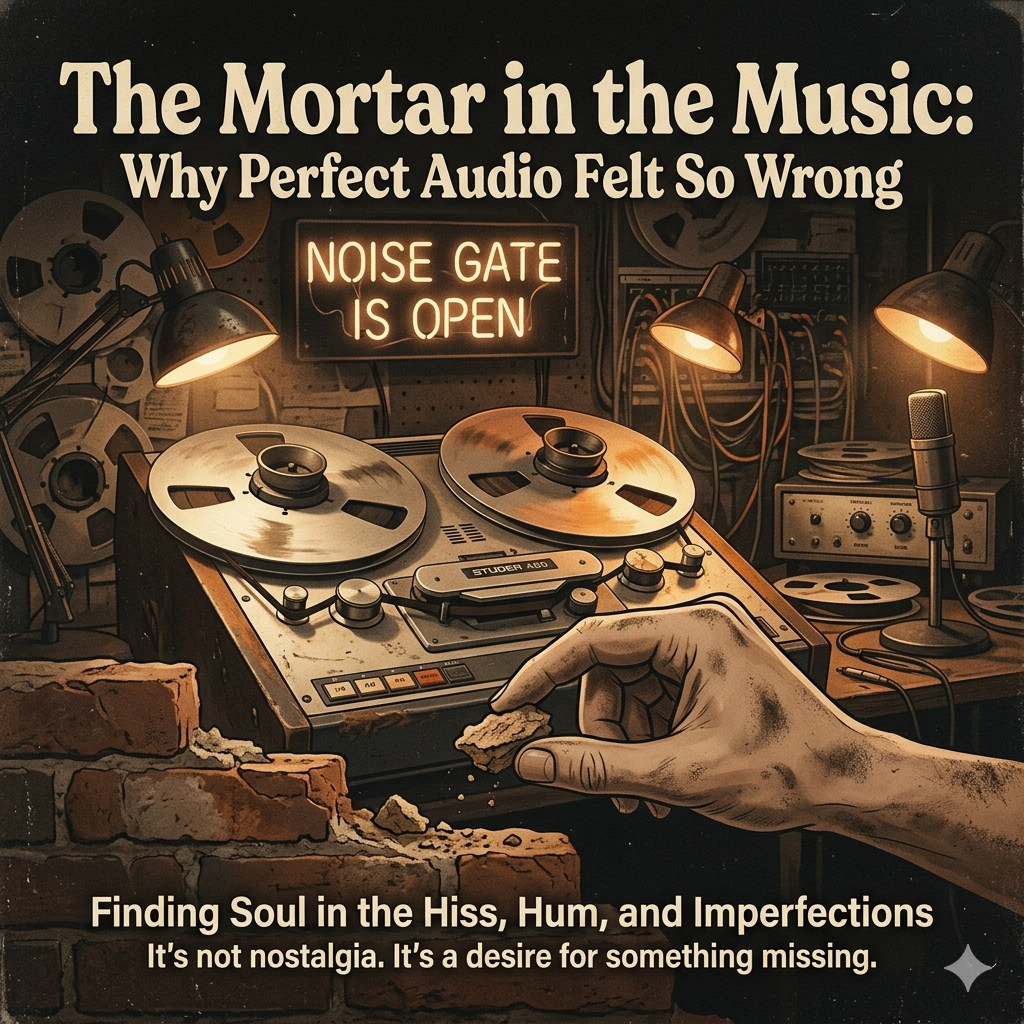
The Mortar in the Music: Why Perfect Audio Felt So Wrong
There was a time when hiss, hum, and the aggressive clunk of noise gates opening and closing weren't mistakes—they were just the sound of recorded music. Some of the greatest, most revered albums of all time carry a distinct sonic signature that openly reveals the limitations of the gear used to make them.
I remember the 1980s, when we fought tooth and nail to wring the best possible sound out of magnetic tape. Back then, companies like Dolby and dbx were everywhere, promising to cure the industry of its collective curse. God, what we wouldn’t have given to just get rid of that bloody tape hiss.
But tape wasn't our only adversary. We were constantly battling room hum and bleed. We’d spend what felt like an eternity wrestling with noise gates, trying to get them to open and close seamlessly—clamping down on the bleed from the drums without cutting off the delicate tail of a vocal or guitar note.
If you listen closely to the very opening of "Roxanne" by The Police, you can actually hear those gates working. Or listen to the background noise on Marvin Gaye's "I Heard It Through the Grapevine." I could name hundreds of tracks where these technical imperfections are laid bare.
The Digital Revolution (and the Lie We Believed)
Then, the world changed. Digital recording became a reality. At first, it was a luxury reserved for elite studios housing massive, expensive machines from Sony and Mitsubishi. But soon, the technology trickled down. Many of us practically danced around the room when Alesis ADATs and Tascam DA-88s arrived, democratizing digital recording for the masses.
Suddenly, the entire signal chain went digital: effects units, mastering chains, samplers, and synths.
"The days of noise are over," we proudly declared. And this was well before the advent of modern DAWs, endless plugin suites, and AI.
There’s a joke that’s been doing the rounds in pro-audio circles for years:
"We spent decades wishing we could get rid of the noise, and the second we finally did, we bought plugins to put it all back in."
The best jokes always contain a painful element of truth. The more you listen to classic analog recordings, the more you realize that the imperfections we tried so desperately to erase were the very things that gave the music the soul we still crave today.
It’s why social media and audio forums are flooded with people obsessing over summing amps, vintage hardware, and plugins that emulate tape saturation. This isn't a placebo, and it isn't just misty-eyed nostalgia; it’s a genuine desire to find something that has gone missing.
Deconstructing "Roxanne"
I recently put this to the test. I attempted to deconstruct "Roxanne," using modern, cutting-edge tools to strip away the imperfections and clean up the track.
The result? It sounded terrible.
By removing the flaws, I stripped away the life. The track felt utterly disconnected. In the audio world, we talk a lot about "glue"—that magical, intangible quality that binds a mix together. But I’ve come to favor a different analogy.
I live in a Victorian house built around the turn of the last century. Own a house like that long enough, and you’ll eventually need to have it repointed. That means grinding out the old, crumbling mortar between the bricks and replacing it. It’s not just cosmetic; that mortar is what keeps the elements from destroying the structure.
I spent a massive portion of my career looking for magic tricks to clean up my recordings—first with noise gates and Dolby, then with digital tape, DAWs, and AI. But I’ve come to the conclusion that all that "noise" we tried to eradicate was actually the mortar holding the bricks together.
Technically Right, But Musically Wrong
Do I want to actually go back to the logistical nightmare of old technology? Not a chance. I have brief moments where I think about buying a vintage tape machine and a giant console to do it "old school," but then I come to my senses. This isn't about romanticizing the "good old days."
The real issue isn't just the gear; it's our modern obsession with flawless execution. Today, we want everything perfectly played, perfectly locked to a grid, and perfectly in tune. But in chasing that ideal, we often end up with soulless perfection. It ends up technically right, but musically dead.
I don’t blame engineers for trying to get things right, nor do I blame producers for buying into a massive industry dedicated to putting the "mojo" back into digital audio. The market isn't a scam; it’s responding to a very real, collective sense of loss. (Even if I don’t agree with every snake-oil plugin claiming to solve it.)
In our frantic search for perfection, we lost the very thing that holds a performance together: the human element, mistakes and all.
There is still so much to be said for the magic of a live recording. Maybe some of us just need to step into the studio, throw out the grid, and say, "Screw it, let’s just get this down." Try it on your next session. It might just be the best thing you've recorded in years.